
I slip my knife into the bellies of cod that do not fight me and think: this work was far from my first pick. When I fled home, I wanted something far from lecture halls, far from factory floors, far from the kitchen basins where women bend their spines one dish at a time. And yet here I stand, hands raw, apron stiff with salt and viscera, just with the promise of invisibility. Half-frozen fish-leather bellies that open like they’ve been waiting for it.
Carving up under the gills, blood gushes onto my hands and my mind wanders home. My father and his friends haunted the pub with the best cable television. I couldn’t drive past the place without feeling sick. At least liquor itself doesn’t remind me of him. The harbor town’s widow matriarch, Ms. Daugaviete, brews sweet spirits from walnut scraps. It warms me more than coffee alone in my thermos ever could, which is a necessity in the harsh cold.
She works on the conveyor opposite me now, face stiff as she mirrors my gutting, but more apt. She’s not much older than myself, probably in her forties, but her face betrays her. The wrinkles around her eyes and forehead are deep from squinting at the shine of the sea, lips thin and split from the cold. I wonder if her knuckles are as cracked as mine. I doubt the plant was her first choice either, though locals have fewer options than someone like me.
“Līdz cikiem tu strādā?” A passing dockworker calls to her, patting a heavy hand on her shoulder as he goes by.
“Līdz manām rokām nokritīs,” she responds, which makes him laugh a short huff.
It’s not something meant for me, made obvious by the language I don’t understand. Her eyes meet mine for a moment as the man passes, lips still parted with her half-smile, but her eyes aren’t filled with joy. It’s pity when she looks at me, the foreigner. I don’t think of it. The crews split their languages—Russian dominates, Polish, English, Lativan linger—I understand commands, questions, and the coast guard, which is enough to stay out of trouble.
The foreman passes through, tight eyes squinting down at his clipboard. He has a snide tone that makes my hands clench.
“Tóth, Nikoletta. Break time.”
“Had my break earlier.” I keep my eyes on the fish’s gills.
“Not according to the ledger.”
He’s right, but I don’t want to return to the pub in my mind, so I refuse the silence. I plunge my knife into another cold belly, carving to its jaw.
“I’ll go in five.”
He gives me a half-annoyed grunt as confirmation, leaving me alone.
When I look back up, Ms. Daugaviete is staring at me. She jerks her head toward the doors and sheathes her knife, and I follow. When we’re out back of the warehouse, she holds an expectant hand to me. It takes a second for it to click, and I nearly drop my cigarettes into the snow when I pull them out of my pocket. I palm her one and have to shield the icy sea wind from her with a cupped hand as I light it. The flame dances in her watery eyes.
—
It reminds me of smoking with Mr. Varga, my father’s closest work friend from the mill and a regular at the pub he haunted. On my last visit home from University, he had spoken to me by the corner-store over a cigarette. Hushed–shockingly sober.
“He’s been… restless. Started betting on poker instead of horses.”
“And?”
“He’s deep in the hole already, but it’s not just that. He talks about your mother every night.”
I eye him. Why tell me this?
“You know how he was, but he’s desperate now, too. Keeps saying she’s living too easy. Says everything she has should’ve been his, if she hadn’t lied about him.”
I press my tobacco-stained fingers into my temple.
“He has some… idea,” Mr. Varga says quietly. “He wants to hit the house, not just for cash. He wants to scare her. Shake her up.” His guilty eyes stay fixed on his boots.
“You’re fucking with me.”
“I wish I was.”
—
Ms. Daugaviete flicks ash into the ice we’re standing on and speaks to me in the same hushed sobriety.
“The foreman won’t last a year. They never do.”
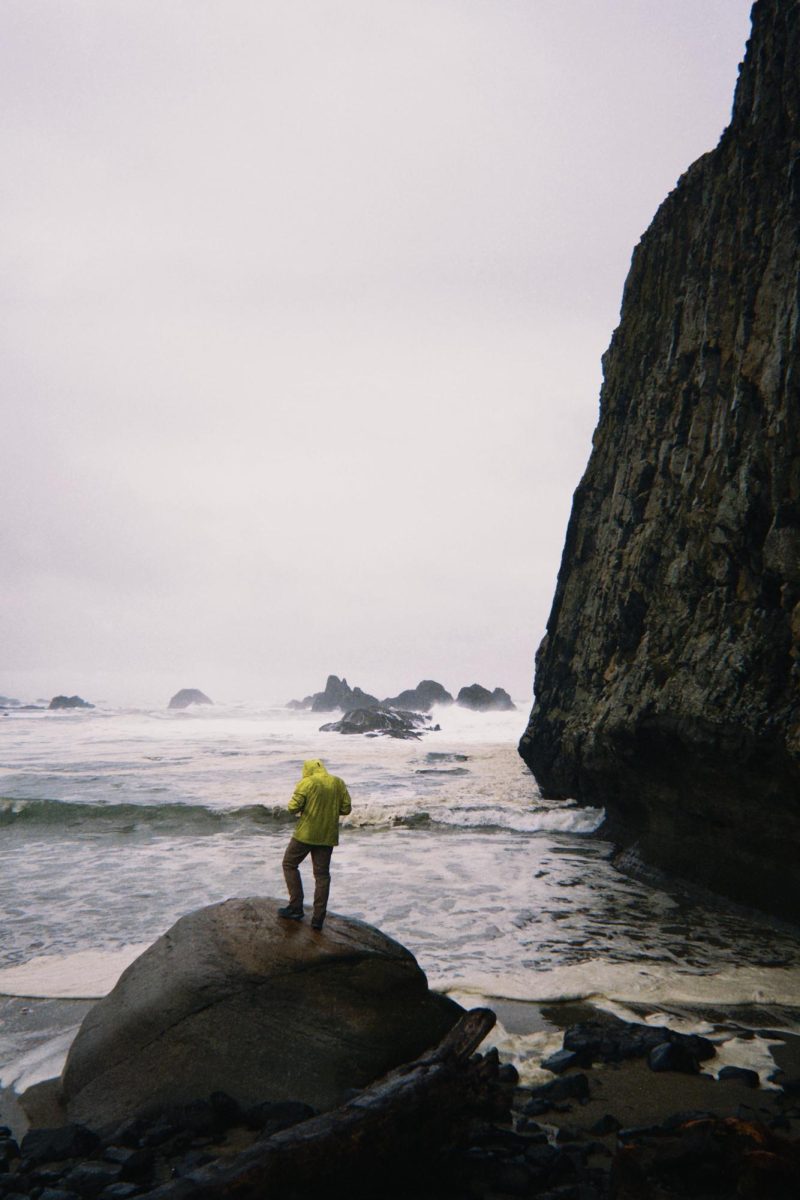
“Good riddance.” I snort a puff of warm fog out of my nose. It gets dragged straight west from me along with the smoke to join the mist lingering over the black seawater. It’s far from quiet, black skeletons of cranes rising from the fog, lifting shipping crates off a barge. Gulls and cormorants coexist, swirling above harbor dogs who tear at a discarded fish carcass.
“They say the unions make life hell for them. I don’t know how true that is anymore.”
“So I’ve heard.”
She continues, in her own world. “I don’t give them grace. We all know what they are paid.”
“Good to know.”
“Not many women last longer than foremen. Hardly any.”
That hits me in a spot that’s still sore.
“And?” I say, a vitriol in my tone that lingers from my teenage years. I sound just like I did at nineteen. I regret it immediately.
She puts her hands up, feigning surrender. “God forbid I discourage you. Me, of all people! I only hope you’ve found some friends. That is all.”
I force myself to even my temper. “I do fine for myself.”
“Then… good to know. That’s all.” She mimics my tone from earlier. “That’s all.”
The blood in my neck warms with a defensive heat, but I exhale it out into the eastern air. She’s being kind—matronly, even, not deprecating. It’s not what I’m used to.
“You are… Magyar, yes?” She continues.
I nod, a nondescript, “mmn.”
“I’m making pálinka for you. Apricot.”
I almost laugh. It’s my least favorite liquor, more medicinal than drinkable. I’ve learned to prefer the Latvian black balsam over any fruit spirits from my hometown. I don’t disparage her, though.
“Oh, really? My uncle used to make it in spring. Earned more money than his day job.”
“I want to remind you of home. It can be harsh here.”
“No need. I like it here.”
“Really?”
“Mmn. Even more on the water.”
“You must have hit your head very hard as a child.” She says, deadpan, and I can’t help but choke on my laughter, the warmth of my blood and the smoke in my lungs rising to my cheeks.
—
Graduation was supposed to be freeing. Even in Budapest, I still smelled my hometown mill’s corpse on my clothes, saw the shattered glass teeth of its windows. Four years of Hungarian literature, sitting through lectures full of men quoting Ady and József like psalms. I’d watch their mouths flapping, eyes empty, and wonder if they’d ever scrubbed mildew from windows or hauled dishes until their spines screamed.
The blocks of Dunaújváros were supposed to mean progress. Concrete poured by the ton, each window a promise of a better life under Lenin long before I was born. By the time I walked myself home, the stairwells already smelled of piss and burnt grain. The elevators hadn’t worked in years. The slogans were gone, but the suffocating walls stayed.
I told myself that I left for normalcy, but what I found in Budapest was credit shattered by rent, useless jobs completely unrelated to literature, and utter emptiness. I moved back closer, to Székesfehérvár. Told my mother I moved to be closer to her now that she was living alone. The truth was that I couldn’t stay afloat alone. My degree ground me into mince, spit me into cubicle farms, warehouse-sized halls where tech giants hired every new grad in sight. I got stuck cold-calling, translating, staring at data sheets until my eyes stung from the fluorescent lighting.
Székesfehérvár to Dunaújváros, my home. Fifty-three kilometers of grain fields. Forty-six minutes of silence in the car. I still see the route when I shut my eyes. I did it once in just thirty-nine. Adrenaline changes driving the same way it changes running.
The only thing of my fathers that I saved was an antler-handled folding knife, he gifted it to me when I turned ten. Hardly an appropriate gift, but it proved useful. It sat beside me on the passenger seat then, as I sped back.
—
When Laima, our battered ship, pulls into Liepāja’s harbor after our next, the deck is still pitching under my feet. I’m tired, beaten, weary and roughened up, but the thought of the quarterhouses—four walls filled with silence and the stink of damp sheets—makes me want to throw myself back into the sea. She’s there on portside, not working, just waiting. I can see the ember of her cigarette first, then the shape of her with the cranes behind her, black against fog. She must have known how bad it was out there. Word travels onshore faster than the boats get back to harbor.
When my boots hit the gangway, she doesn’t wave, doesn’t call out. She just watches. Janis, one of my fellow deckhands who’s off the boat ahead of me, is beside her, saying something low, his hands shoved into his coat. She doesn’t answer him. When I get close enough, her eyes catch mine and hold, and for a moment I think she’ll turn away. Instead, she looks me over like I’m one of the spare shoes we pull up from the nettings. Then her mouth turns, not into a smile, but something concerned.
“You’ll freeze before you hit your bunk,” she says, flat as a lake.
“I’ve done worse for myself.”
“Not tonight.” She flicks the ash into the slush, then looks back at me. “You’ll come eat.”
It isn’t a question. It’s the same voice she uses with the men she lets in on Sundays, the ones who stagger out of her flat smelling of pork fat and cheap spirits. I’ve seen them follow like dogs, grateful for warmth that isn’t their own.
I want to tell her no. I want to keep walking–stiff and salt-cured–back to my rumination. But she turns and starts down the quay without waiting for me, and I follow, because that’s what you do when the harbor’s matron decides you’re her responsibility for the night.
Her home is close, two streets up from the water. She kicks the snow off her boots and sets into the bathroom to draw me a bath I didn’t ask for, before shoving me into the room with the steam.
She doesn’t allow me privacy once I finally sink into the warm freshwater, instead barging into the bathroom after just a few moments’ silence. She has a tray of goods that she sets across the edges of the bath as I pitifully try to cover my chest. Hot soup, some kind of wine, soap and a rag… salts?
“Epsom, for the ache,” she clarifies in response to my confused gaze, and she pours it under the tap as it fills the last few inches. She spares me no time to adjust as she begins to lather the bar soap along the ridges of my back before digging her thumbs into the tension. It is heavenly. My hesitation melts and I don’t bother covering myself in her presence anymore. She tells me off for not taking care of myself, a lecture that reaches my ears but doesn’t quite register, as my eyelids are starting to droop. She reminds me of carrion crows allopreening after eating viscera. She has no reason to be kind or gentle, but she is.
I fall asleep in her bed, beside her, with no issue.
—
I bust into the door, shoulder-first, like a woman possessed. Again, and once more until the old moulding cracks and it swings open. Inside, I hear her, moaning like an injured dog. It’s my mother, muffled by the sound of another thick thud, her body hitting a counter or the floor, and the clattering of plates. Once I’m in, I shout something. I remember the layout of the home just like the steps to the pub, the drive to my flat–but I don’t remember anything I said that night.
The long hallway to the kitchen feels like home, yet sickeningly unfamiliar. He stands half-hunched over himself, backlit by the kitchen lights. He’s long since abandoned whatever guise of anonymity he was aiming for. He has my mom’s blouse in his fist, her crumpled beneath him. He’s still in his dirty coveralls.
He looks at me, eyes wet and big, like he’s terrified of me. I shout something again and I hear my voice crack.
For a moment we just stand there, both frozen, silence like fog in the hallway. Then his face changes, softens and goes blank, like something in him has given up. He lets go of her, relaxing his fists at his sides. He takes a slow, dragging step toward me.
I do not know when I opened the pocket knife. I do not remember even carrying it into the house. My hand is around it so tight my nails hurt my palm. The whole world shrinks to the few feet between us. I shut my eyes because I don’t want to watch him come any closer.
I hit him hard. The knife sinks into his stomach with a horrible, thick resistance, like pushing through wet leather that flails when I sink into it. Heat floods over my fingers so fast I gasp. His blood runs between my knuckles, and the shock of it makes my stomach flip so violently I almost choke.
I open my eyes. He is right in front of me. His mouth twitches into something like a sick smile. I press against him without meaning to, my hand buried in his blood. He does not even raise his hands to me. He only watches me with a strange calm. He knew this would happen.
He doesn’t fight me when I put pressure on the wound deep in his gut to stop its bleeding. I hear my mother’s shaking voice yelling over the phone, presumably to the police. I remember nothing past the empty, black seas in his pupils.
—
I awake with a jolt but no surprise. The nightmare is incredibly familiar, but I’m lying somewhere new. My hands grip at a thick quilt instead of my usual ratty dock-house covers. Light filters in through gauzy curtains.
She wakes with me. I didn’t see her come to bed, too exhausted to wait once my back hit her thick mattress, but she looks like Eve, awoken in the garden before dawn, still mussed with sleep. Even as she is, all bed-head and squinted eyes, heat rises in my chest. She rubs at an eye with broken-nailed fingers, and instead of asking me what was in my head, she simply asks what I want to hear:
“What time is it?”
I pry my eyes from her to look at my watch on the nightstand, photo of her with her family in the background. “Quarter-past four,” I groan as my eyes wander to the framed group shot. It’s her, maybe ten years ago, stood beside a gruff-looking man quarter meter taller than her, arm laying heavy around her shoulder. Their eyes are on the two children hunching in front of her, preteens, boy and girl, leaning on each other and painted with half-silly smiles.
I roll back to look at her and she’s covering her face with the palm of her hand, rubbing at her eyes. I reach to her like a babe, fingers stroking down the back of her hand to her wrist. She twitches when I do, corners of her lips betraying her usual stoicism. She knows what I want to ask.
“My husband.” She nods towards the photograph past me. “He passed on a ship in February, seven years ago. The crew just vanished. Who knows.”
“I’ve heard about that. I didn’t know.”
“And my son… he was always sickly. Pneumonia got him three years after his father.”
“I’m so sorry, Ms. Daugaviete.”
“Ieva.” She corrects me, her eyes averting from mine. Instead they pin at the ceiling as she lays back on her tired shoulders.
“I’m so sorry, Ieva.” My voice cinches in my throat this time, emotional. It’s humiliating–this is her grief, not mine. I say no more.
“I’ve been staying put, some sort of false hope that he will come down the gangway someday. Or perhaps there’s word of some kind of… remnants of the ship. But he knows what work he got into, and so did I. I just never believed that it would come back to us.”
“Does staying here make it feel better? The grief?”
“I’m not so sure anymore.” She answers quietly; earnest.
“…Then leave.”
“That’s easy for you to say.” Her tone is snipped short. I can tell I’ve screwed up right away.
“I–” She cuts me off.
“I am going back to bed, Tóth. I would suggest you do the same.” She hisses my family name like it’s a curse, and it stings in my chest like it is.
She rolls away from me, tucking her hand back under the covers, and the silence envelops me like a wave. It seeps into my clothing and the cold nips at my skin. I pull the covers back and stand, fumbling my way out of the dark room and back into her kitchen. She doesn’t come and stop me as I pull on my still-damp jacket from where it hangs in front of the fire and shove my boots on. There is no sailors cabin that would board me at four in the morning. No matter. I plan to go to work anyway. In spite of the cold weather, ships are still headed out to sea.
—
There is nothing but ice in my face now. The wind whips at every inch not covered by oilskin. We’re hauling up north, cutting through sea ice to drag herring en masse. The tide has gotten vicious, slamming the bow and throwing sluices of freezing water onto the deck. I’m tending the lines of the massive nets we drag through open waters to avoid tangles or catches, or freezing over.
Looking out at the waters, even with illumination from lights on the bows they’re pitch black. With the turbulence, slush is pulled to the top and crests in little white peaks in the void. When we turn, the waves slap starboard and spray me with wet ice. One may find this work inhuman—suicidal. I welcome the oblivion. The only part of life on land I miss is Ms. Daugaviete.
The rocking rhythm of waves has seemingly settled until it upheaves in an instant. The hundreds-ton boat catches on portside, and even when a wave hits, it lurches then stops dead. I’m thrown from my footing and slam into the railing hip-first. My line catches me by the harness as I look down over darkness over the rails.
Another wave hits and soaks me in slivers of freezing sluice, but I’m pulled out of the throbbing in my muscle and the prickles of bone-chilling cold setting in by the sound of gunshots overhead. No, not gunshots. Lines snapping. They break with such force that the cracking of fibers leaves smoke in the air, and they whip around so fast the crack is invisible.
The bosun screams something from a deck above me. When I turn, I can see the panic drowning his face, even twenty feet from me.
“The net! Get the net!”
I turn and lock eyes on port side’s strained netting, bending the scaffolding that holds it. My blood freezes over. To get there is to transfer my line twice, walk around the cargo and take my sweet time, but with the pressure already tearing steel, there’s no doubt it won’t hold long enough.
I make the decision under my bosun’s eye to unclip myself from the harness, launching myself over crates of packed fish as I get to the taut line as soon as possible. I don’t see a way to untangle it. It must be caught on the seafloor if hundreds of tons of boat couldn’t dislodge it. At that moment, I take the risk and pull my knife. Snapping cords can take a limb, or worse, a life. The tug of a caught net is enough to send more than just me overboard, or to capsize the whole boat.
I cut the line and it releases back into the ocean–along with all of its fish–as the boat is freed into the whims of the waves once more.
I hear the bosun shout again, and it’s only when I’ve turned back toward him that I can make out his lips forming, “No!” as our paycheck escapes back into the ink-black of the sea.
—
It takes three weeks of coldness to speak to me at work again. It’s half my fault, I’m just as standoffish as her. The fear of overstepping freezes me across the cold-room’s conveyor. My shift for today has already ended. The foreman would get on my case if I stayed any longer, so I’m on my way to the lockers. Ieva stands half-hunched in front of her locker, and her eyes flash big when she spots me–she’s seen a ghost. She fumbles with something in her locker as I pull off my coat, before gingerly approaching me. She holds a bottle of pale-tan liquor half-wrapped in a scarf, in her arms like a baby–an olive branch.
“It’s pálinka. For you. It’s done.”
“Oh. Thank you.” My mind fumbles for something else–for a sorry that doesn’t come to me.
“Come. For a smoke. You have to try it, tell me if it’s passable.”
We stand again under the outside lights of the building in the uneasy silence. I take the unmarked glass from her and take a solid swig that stings all the way down. I cough.
I started smoking in college, socially. It picked up in the coming years. For a second, the sting brings me back to my hands shaking, gunpowder tinged, having a desperate cigarette before the police got there. I blink, and for a moment the yard shifts—the lights of the plant melt into sirens, snow into smoke. My fingers twitch like they’re finding a pulse again. I take another sip, forcing the memory back down my throat, the way I always do.
“Strong,” I say, voice gritty.
“It should be,” she answers. “Otherwise, what’s the point?”
My nerves bundle up, pulling my diaphragm up and spasming in my throat. I take another sip and choke, pounding my fist against my chest. I double over, hand on my knee, and she looks at me, concerned.
“Sorry… sorry. I’m sorry.” I’m choking on my words, breath coming short to me. I’m crying. I feel the weight of her hand on my back and her eyes on me as I hold onto my pants and huff a breath in.
“Fuck. I’m sorry,” I grasp for something coherent and fail, looking at her desperately, instead. I’m sure my eyes look wild and huge and watery. “When I was with you. I’m sorry.” I’m frantic.
“I came here because I was fleeing home. I did something bad. Bad, Ieva. And I left because I couldn’t handle the grief anymore. I couldn’t look at the people who knew anything about it. I don’t know how you do it. That’s why I– It was stupid to say that to you. I can’t imagine. I can’t.” She cuts me off, squinting at me with something that looks like suspicion.
“That doesn’t sound like grief. That sounds like guilt.”
That’s not what I was expecting her to say, but she doesn’t sound vitriolic. Not even a bit.
“I’m not guilty. I had to.”
She sees right through it, years of her own self-blame softening her tone. She takes a deep breath before speaking again, her tone tight but soft, far too kind. “Is that really how you feel?”
I answer far too quickly. “No. No.” I gasp in another short breath, and it comes out in stuttering creaks, like a wounded animal. Pure humiliation. She looks at me with eyes that are far too tender for a coworker.
“Come home.”
“What?” I look at her with a face I’m certain looks mad, still breathing like I’ve run a marathon.
“You left early, last time. You didn’t eat breakfast. Come home.”
I look back down guilty at my boots, grief pulling at my chest again. When I speak, my voice is pathetically small in my throat.
“Okay?”
She crosses her arms. “Is that a question or a statement?”
“Okay.” I say, finally catching my breath.
“Good. Come on. Tomorrow is Good Friday. You can sleep in.”
She tucks an arm around my back, walking me away from the lights of the plant. The path along the docks is wave-worn, right beside the water’s surface. When I look down at it, our reflections muddle together into one flexing shadow.
The tide rises and pulls away, and the reflection of me goes with it.