

They walk towards me with the sun glowing in their eyes and the wind blowing through their hair. Their eyes twinkled with knowledge I have never seen before. I usher them to sit down next to me. With cautious hands, they slowly let their fingertips reach the bench and silently bless it for all it has to offer. Smiling at me, they slowly lift their head and nod, as if ready to begin.

Paganism – or witchcraft – has been a spiritual practice that has been scrutinized, and even deadly, for centuries. From the Salem Witch Trials to the lack of accurate representation in the media, modern-day witches don’t have many positive memories to look back on their history. Today, witches are located on all continents all around the world. Some work in covens, while others enjoy their individualistic practices. While they are prevalent in numbers, many witches tend to be less outward about their practices. Those who are, however, show their spirituality through their style, gender expression, and daily practices.
While discovering the lives of witches all over the country would be interesting, I wanted to focus my story here at home – in Corvallis, Oregon. Specifically, at Oregon State University. Every one of their stories has proven to be both unique and inspiring, each witch with their path and interests. So, take out a handful of crystals, turn on some Stevie Nicks, and relax while reading about the eclectic witches of Oregon State University.
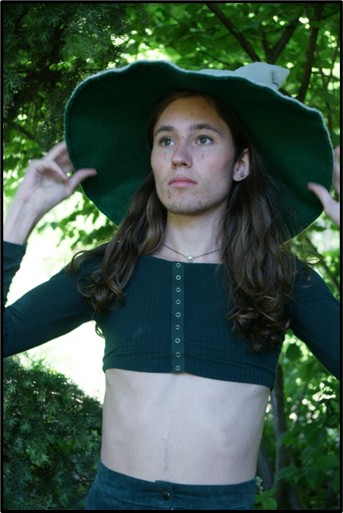
Zane (they/them)
Zane has been practicing witchcraft since their freshman year of college. One day, they decided to check out the Pagan Club, and realized “Oh, these people are legit, it’s not a cult.” Then, they recruited their two friends, Lani and Ari, to join. Their practice is individual. However, they love to practice with others and form a community with spiritual students who have similar beliefs.
Zane believes that Paganism is “all about finding the self through forgetting the self, and realizing that there is no true separation between you or anything. That applies well to Paganism where we do not see ourselves as separate from the earth. We are focusing on the earth and we focus on feeling the earth as an extension of ourselves and appreciating every one of ourselves and seeing the connections and that we’re not separate.” Oregon State University professor of Women, Gender, and Sexuality studies, Kryn Freehling-Burton, agrees with this, as she believes that many Pagans are initially drawn to the practice itself through the appeal of earth-based spirituality. She notes that “Christianity is built on the idea that we have to have dominion over the earth. [Paganism] is a completely different worldview, of what our relationship should be with plants, animals, our soil, and our water systems.” She believes that the earth itself and the energies it brings to the table is what make the craft so attractive to a wide variety of different people.
Not only do the Pagans appreciate every concept within the earth, but other elements as well – such as water. Paganism expert and author, Patti Wigington, shares that the element of water is traditionally a feminine one. It is used to purify and cleanse. Much like the Christian use of “holy water,” Pagan’s use of water is a sacred one. Many will leave water out under the full moon, to let the moon charge the water with its energies. Zane shares a metaphor about practices and the oceans. They explain that “practices are like the tides, you know, they come in and they come out and each new wave brings something else with it – so we’re always changing practices.”
The idea of life is a practice that Zane takes very seriously. They believe that “everything that’s happening is just an unfolding and a manifestation of the universe. We’re conscious and we’re able to be aware of that and feel those things and every moment, everything that happens cannot be judged, it is not good it is not bad it is simply an experience and we’re here to experience those things.”
Partway through the interview, Zane closed their eyes for a moment and let their hands drop to the birch tree bench we were sitting upon. Slowly, their perfectly manicured nails, adorned with crystal rings, felt the bench and they started to bless the seat. They explained that touching the bench is “consciousness touching consciousness. It is the universe touching itself and feeling itself, folding it on itself and everything that happens. It’s just a larger being in its pieces and we’re all part of that kind of collective.” A 2016 petition agrees with this. Journalist, Atonia Blumberg, writes about the “Pagan Community Statement on the Environment”, an initiative that notes that “we are neither above nor separate from the rest of nature. We recognize the ancient wisdom that closeness to nature brings closeness among humanity and all living beings; and when we live as if we are separate from nature, we diminish our compassion for ourselves and others.” This initiative shows that Pagans and the earth are divinely connected, and their passion allows them to take the lead on politics regarding the things they love.
Because of the collective nature of the spirituality, Zane loves using the gender-neutral pronouns of they/them “not only for neutrality” but also “for the plurality of feeling very connected [to both the divine masculine and feminine].” They note that in many different cultures, “the binary is very much set up like that it’s feminine, it’s masculine,” but instead of the normal binaries of black and white – zeros and ones – Zane is a big fan “of ambiguity and grayness – the area where things are complicated, they don’t make sense – and also contradictions. I think multiple things can be true at once and it doesn’t compromise the other.” Boston University professor of Sexuality and Literature, Christine Hoff Kraemer, notes that Paganism is one of the most queer-accepting spiritualities. Many Pagans “struggle with essentialist notions of gender,” Kraemer states, and they are one of the most vocal communities within queer politics.

Lani (they/them)
Currently a senior at Oregon State University, Lani’s practice is very eclectic. Wearing Celtic rings and crystal earrings, their sleeves flow in the wind as they cross their legs on the bench, and make themselves comfortable. They tell me how their practice is so individualized. After talking about their past, they told me that they were raised Catholic, which affected the way they saw religion as a whole. While they were “devoutly Catholic for a long time,” they experienced “prejudice in that community towards [their] queer identity.” They had to come to terms with the social implications of Catholicism and the patriarchy that it relies on. Catholicism has to enforce this to maintain itself. Lani learned more about Paganism when they left the church due to discrimination They describe their journey, stating that “after going through a period of being atheist, I found that I had this spiritual hole that I knew that wasn’t going to go away. I needed to have some sort of ritual practice to connect me to the force around us and the life that connects everything. That is the center of my practice.”
Lani does most of their practice through “divination – which involves using objects or signs to find meaning in the past and the future. My practice is just for me, it’s for me to get more guidance in my life.” Wigington states that some of the benefits of a solitary practice include choosing your schedule and not dealing with some of the toxic dynamics of covens. Although Lani is in the Pagan Club at Oregon State University, they practice solo most of the time, since their practice is for self-exploration and growth.
Lani adjusts where they are seated and looks over at Zane. Lani, bursting with enthusiasm remarks that “part of Paganism for me, and I think for a lot of folks, is the idea of humans being divine and having divinity within ourselves. For me specifically, the divine power of creation and transformation has always been very intriguing to me. Being a queer person, the idea of divinity has strong ties to my spirituality because I’m able to respect the divine femininity and the divine masculinity and also the divine androgynous that all reside within me. They all give me different ways of understanding things.” Professor Freehling-Burton notes that queer Pagans find a community out of their exploration of their sexuality and spirituality together. Many queer witches are “in these communities where it’s just acceptable right to to to think beyond the binary.” She explains that “there’s a reason people go to church or pray in a mosque. There’s power there when you’re together and you’re saying the same words or singing together. I think for people, for some people that desire to be in a spiritual community that accepts people for who they are is extremely important to their livelihood.”
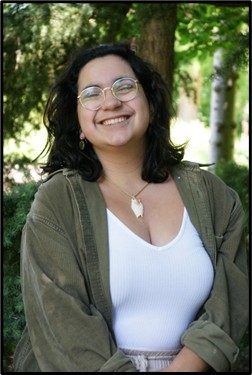
Ari (she/they)
Ari is also a senior at Oregon State University. Their practice is predominantly individualistic unless the practice involves more than one person. Ari self-identifies as a craft witch. They enjoy “making something, music, physical art, basket weaving, or anything using their hands. Ari explains that “when I’m in that moment doing it, I find myself appreciating the earth more than I do in my everyday work.”
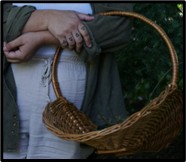
Ari participates in a craft that many Pagans label as kitchen witchery. This is the practice of using intention and certain ingredients for different reasons in the kitchen. “When I’m making something, I use a lot of intention in the way I’m doing something/in the way I’m cutting something or the way I’m putting oil in the pan. Everything is intentional and everything is in place and I love putting that intent into the food. People say you cook with love, and that is it,” Ari states.
While over at the apartment of Zane, Ari, and Lani, Ari showed me some of their kitchen witchery skills in action. To get the most out of their morning routine, they hand grind their coffee every day. They also intentionally stir tea a certain way for different outcomes of the day. Witches say that stirring clockwise brings manifestations into existence. Stirring counterclockwise banishes negative energy, and stirring in the shape of a hexagram will protect the user. Wigington shares the importance of kitchen witchery in their article “What is Kitchen Witchcraft.” She explains that the kitchen brings “a magical opportunity at hand.” Those in the kitchen can “infuse every dish with intent and will…. By changing the way you view food, its preparation, and its consumption, you can craft some practical magic at its simplest level.”
Not only does Ari do kitchen witchery, but they also practice Hellenism, which is the devotion to Greek Gods and Goddesses. Ari mostly works with Athena, the goddess of craft and wisdom. Because they are a craft witch, anytime they use their hands “is my Athena time. I could spend hours doing something and it just feels like a presence and it’s that energy that I bring into the craft. I attribute that energy to Athena.”
Lani, Zane, and Ari researched a lot of their beginning craft a while ago. I asked them how they found their information, and they said that “there was a lot of internet…so that was helpful to a certain extent. It’s helpful when you’re new in your practice too; kind of dip your toes into it through very surface-level magic and then you start to do more of your spiritual work and reflect.” Professor Kryn Freehling-Burton shares that the internet is a great place to start, but books will give the user more intricate information. While resources such as TikTok are popular, with the rise of tags such as #witchtok or #cottagecore, the youth of Pagans have access to a world of information at their fingertips. However, if they want to know the accurate history of witches, or learn about the magic of Paganism deeper, the books will have more reliable sources.
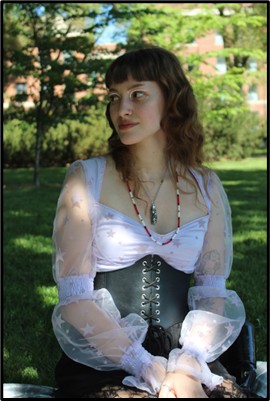
Ken (they/them)
Sitting on the steps of Oregon State University’s Memorial Union, I spot Ken in their “witchiest outfit.” They are sporting an astrological top, a tight black corset, and the tallest platform boots I had ever seen. I asked them about their jewelry, and we got into a ten-minute conversation regarding the stories behind their adornments. They wore a red and white beaded necklace that their favorite singer, Jim Morrison, always wore (they even have a tattoo of him on their arm). Morrison means everything to Ken, as they explained to me that their music means everything to them – he’s always been a comforting and spiritual figure in their life. The second necklace is an urn with their uncle’s ashes in them. Finally, the ring was given to them by their first Pagan friend. Ken explains that they will “ just wear whatever I want. I don’t care what anybody thinks and I think [my gender expression relates to my spirituality] because there’s a certain style in my head that I’ve had that correlates with my spirituality. I grew up as a flower child.”
Ken has “always really been into astrology and the stars”, they state as they tell me about their star sign, moon sign, and rising sign. Each placement of each planet means something different in the astrology world. The constellations fall into categories based on the elements – fire, earth, air, and water. While I knew the basics about my sign (I’m a Virgo), I watched in wonder as Ken went into detail about how the stars aligned the moment I was born and how it affected different areas of my life. I was in awe at how accurate it was, making me go from a skeptic to a full-on believer in astrology.
Throughout my research, I learned that Pagans are very interested in communicating with other realms. Ken told me that they were “really interested in death. I was interested in spirits and communication with people on the other side if you will. So, I think that was a huge trigger for becoming spiritual for me.” After their favorite teacher passed away, Ken visited a psychic at a farmer’s market. They told me about how they were able to communicate with their late teacher, and how being able to reach that dimension was an extremely spiritual experience for them.
Quora (she/they)
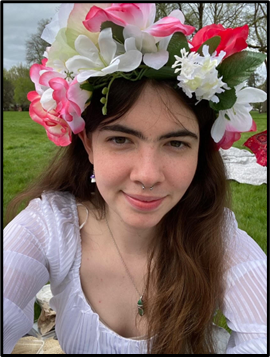
Unlike some of the other witches, Quora had the experience of growing up around common Pagan practices. They told me that “my mom has been doing earth-based practices since I was a kid. It’s something I grew up hearing about and as I got older I’ve gotten more and more interested in it.” They have been around respecting the earth and being “very conscious about my impact on the earth. I use crystals for their energy and the meanings and my friends and I will do tarot readings for each other.”
OSU professor, Kryn Freehling-Burton, talks about the history of tarot. There are many practices and histories of reading tarot, including different stories regarding what each card means. “there are common spreads that get used for card readings, and many of them have been around for ages” but there isn’t one way to do tarot. New York Times author, Gabrielle Drolet, notes in her article called “How to Get Started with Tarot,” explained the basics of a tarot deck. Tarot decks have 78 cards – 22 major arcana and 56 minor arcana. The major arcana cards are used to manifest large events and themes, while the minor arcana is more for day-to-day events. Quora explains that they use tarot to read for their friends or get daily insight into what their day holds.
Quora not only uses tarot as a spiritual tool in their metaphorical spiritual satchel but crystals as well. They explain that they have this “obsidian necklace that is supposed to help block negative energies and influences out of your life. When I got it I had a very toxic person in my life, but when I started focusing on myself and what I needed (the necklace had me start thinking about myself) I became aware of the negative influence the person had on me.”
Kryn Freehling-Burton shares that crystals are made by the energy in the earth. It would make sense that the rock would hold some of that energy in it. Yoga teacher, and Forbes author, Teresa Adele, explains that crystals hold vibrational frequencies similar to the ones humans have. If a crystal has a high vibrational frequency, it can manifest good things into existence through the vibrations, and repel the negative energy. Crystals also manage to work through the placebo effect, which is just as powerful. The intention that the user puts into the crystal can manifest into existence (just like a meditation or affirmation).
Taylor (she/they)
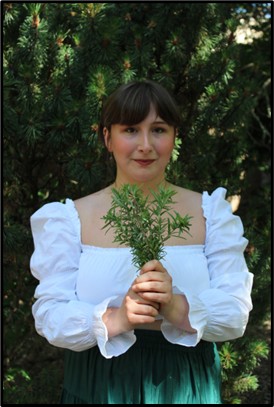
Unlike the other witches I interviewed, Taylor didn’t have a background of being super religious. They grew up with religion, but it wasn’t forced on them. They described that throughout learning about Paganism, they “have definitely developed a practice and not necessarily doing intricate spell work, but just more of like, daily affirmations that have to do with the nature around me.”
When asked about different types of ways Taylor practices, they had many things to say.
For the full moon, they put out moon water and crystals. Moon water is water that has been charged under the energies of the moon – usually the full moon. Freehling-Burton states that “the moon controls the tides. We have different tides depending on the juncture of the moon. Knowing how much of our body pertains to water, wouldn’t it make sense that the moon would affect us as well?” Neurobiology professor at the University of Vienna, Kristin Tessmar-Raible, shares that lunar rhythms affect many organisms and their reproduction, sleep cycles, and migration patterns. Although there needs to be more research done with humans on this topic, evidence shows that the moon is powerful enough to affect species here on Earth.
Taylor also uses nature a lot in their practice. “Specifically, like menstruation practices, I try to go to this waterfall and just free bleed. I love it in the nude and the water because it feels sincere, like natural and grounding.” They further share that “during menstruation is when I feel like garbage and I don’t feel like my most beautiful self, even though in hindsight it is, it is kind of like my most beautiful self because I’m my most vulnerable.” Taylor believes that being in the nude, whether they are dancing in a circle with their friends, or free bleeding under a waterfall makes them feel more human. Professor Freehling-Burton adds to this by noting that by letting nudity be a part of spirituality, it opens people up to the idea that they are beautiful and part of the earth, and it doesn’t matter their shape, size, or sexuality. Many bodies in traditional religions are sacred in the way that they are told to cover up, but in Paganism, the rawness of celebrating bodies in any form is a “celebration of all shapes and sizes,” Freehling-Burton explains. Taylor agrees, saying that “practicing these things has made me like, really love myself and also really love how I’m expressing myself.”
Taylor, along with many other Pagans believes that they are one with the earth. I asked them what the rules are when going into nature. They laughed, and stated, “Respect the land. Don’t **** with it.” They told me that they don’t want to disturb nature, but they still want to be a part of it. They described how they want to use all five of their senses when exploring the earth. They closed their eyes while imagining themself in a field of moss – smelling it, touching it, experiencing it. When Taylor takes mushrooms, their “appreciation for nature and just for the world as a whole” increases and shifts perspective. “Mushrooms help clear the trees in your mind and it brings everything to the surface. Especially in terms of witchcraft and practice…. As long as you’re not harming anyone, we don’t have inherent flaws. We’re all human. We all feel what we gotta feel.”
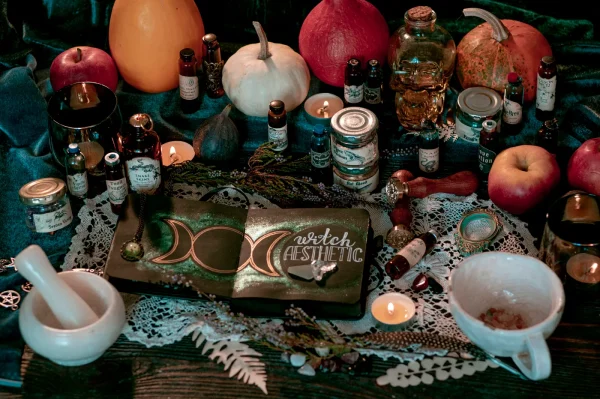
Although Oregon State University likely has many more witches than shown, it was groundbreaking and inspiring to take a glimpse into the lives and the practices of these 6 spiritual students here on campus. While they all practice Paganism in different ways, they are all connected in their beliefs of earth-based spirituality, intentions, and groundedness in the way that they live their lives.
Learning about the witches at the OSU campus opened my eyes to how I could be living my life differently. Appreciating nature to a higher extent, not taking resources for granted, and living day to day with pure intentions were lessons I was not expecting to take away from these interviews, but I am grateful that I did.
Want to learn more? OSU’s Pagan Club is a great place to start. Contact them through @Paganstudents.osu on Instagram. They meet weekly and discuss topics about witchcraft and Paganism. The OSU Clubs and Organizations page is https://clubs.oregonstate.edu/Paganstudents.