
Historical art and historical ecology have been underutilized methods of understanding how landscapes looked hundreds of years ago. These pieces depict a pre-industrialized landscape and can be helpful tools for ecological historians when trying to determine shifted baselines. Shifted baselines is the process of a new generation forgetting past generations’ perception of “normal,” meaning if a problem is worsening, it’s harder to see that progress. This has proven true for climate change, air pollution, and global warming, as it is difficult to pinpoint when things began to take effect. There is a misconception that, because of artistic license, landscape paintings are unverifiable and therefore cannot be used as a trusted source. However, Dr. Dana Warren, a professor of forest ecosystems and society with the College of Forestry at Oregon State University, has worked with a team to accumulate a rubric scientists can use to check artwork for credibility. This has opened up a world of possibilities for the use of historical artwork.
There are four main ways of determining if a piece is credible, starting with determining if the piece is a first or second-hand observation. This can be determined through the artist’s statement or by looking for pieces painted en plein air, which can be determined through size and natural materials caught in the painting (Warren et al. 2023). Second, identify the artist’s knowledge of the subject. Find out if the artist had the necessary ecological and taxonomical knowledge to make a correct painting. This can be verified through intensive note-taking or sketches where the artist was able to correctly identify flora and fauna (Warren et al. 2023). Third, look into the context of the statement. Identifying the broader historical and ecological context of the piece and finding the intention of the piece can help determine what the artist was hoping to achieve within the style and framing of their painting (Warren et al. 2023). And finally, look into what bias existed. Find out if the artist had a special interest in the piece commissioned and if they combined multiple different landscape components to make a more aesthetic piece. There will always be inherent bias, metaphors, and allegories involved in art, but if we can determine the level of impact they have on the piece, we can decide if the piece is credible (Warren et al. 2023).
Sometimes bias can be helpful in understanding human perspectives of natural landscapes at the time, and can be useful for historians to understand attitudes, values, and baselines in historical contexts. Shifted baselines have been a difficult hurdle for scientists to overcome, but art identification has helped in the progression of this. If art historians can identify all four questions, ecological historians can compile pieces for review and comparison. Many case studies have already been conducted and found helpful understandings of not just the way our landscape has changed, but the way we as humans have changed our perception of nature.

Looking into historical paintings of glacial ecosystems, there was a historical attitude of fear and disgust towards these icy environments. There was a religious connection of the cold environment to the devil, and its treacherous waters hosted dangers to explorers who attempted to traverse the areas (Climate in Global Cultures and Histories: Promoting Climate Literacy Across Disciplines, 2021). An oil painting on canvas titled “Pêche au morse par des Gröenlandais, vue de l’Océan Glacial (in English: Greenlanders Hunting Walrus: View of the Polar Sea),” painted in 1841 by the French artist François-Auguste Biard, was sketched en plein air and finished when he arrived home (Matilsky 2013). He wrote in his artist’s statement that he had purposely exaggerated the glacial shapes. Portraying them as the monstrous figures with broken boats at their base to display the perspective he and his fellow voyagers viewed them through (Matilsky 2013). This artist statement discredits the glaciers as a direct comparison to the glacier formations of the times, but gives insights into humans’ attitudes about glacial formations and their fear of this perceived unnatural environment.
This would trickle down in attitudes to how we address global warming and glacier melting today. There is a bias passed down generation to generation that nature is something to be controlled by humans, or else destruction and human death will occur, and this further exacerbates climate change impacts and social ideology of the environment.
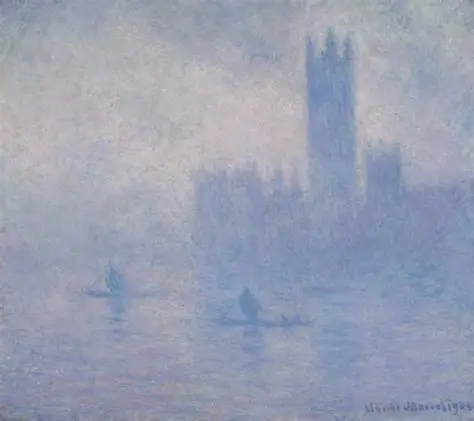
Looking into pollution and atmospheric climate change impacts, Claude Monet, a French painter of the 19th century, created a famous piece titled “Houses of Parliament (Fog Effect)” that became a major source of identification (Albright & Huybers 2022). Air pollution contributes to climate change problems through the ozone layer, global warming, and human health harm (Campbell-Lendrum 2018). The rise in poor air quality leads to rising levels of hospitalization from respiratory and cardiovascular-related ailments, resulting in higher insurance levels and leading to economic impacts on people across the world (Liu et al. 2021). Furthermore, air pollution affects BIPOC communities regardless of location, leading to disparities in affected communities (Marshall 2021). However, this recognition of air pollution wasn’t always the case, and when examining Claude Monet’s paintings from London, we can see how people viewed the smog left from the industrial revolution and coal burning for trains, boats, cooking, and heating as dreamy and admirable (Albright & Huybers 2022). Monet specifically would travel to London to paint low-visibility, low-contrast landscapes of the London skyline. His clear artist statements admiring the smog gave him credibility.
This glorification of air pollution would trickle down into a lack of urgency, as air pollution was in its early stages of development globally. Only now that we have found out there are many negative effects, have perceptions begun to change. This baseline belief that air pollution was not dangerous but instead beautiful, hindered the understanding of its dangers and set back human urgency in climate impacts.

Finally, looking into natural disaster impacts on longer-term atmospheric change, paintings have been used to determine impacts from volcanic eruptions. A study analyzing the ratio of green to red colors in sunset paintings painted from the 19th to 20th century created a comprehensive review of the level of Aerosol Optical Depth, also known as AOD, present in the atmosphere after a volcanic eruption. Art historians and ecological scientists worked together to determine that the darker red the sunset, the more AOD was present in the atmosphere (Zerefos et al. 2014). In the event of the Tambora Eruption, historians discovered that right after the eruption, a thick coverage of ash and trapped gas in the atmosphere caused a year with no summer. Because the sun couldn’t reach the Earth’s crust, societies were left to survive through famine and unusual cold weather. This is confirmed not only through historical texts but through art from this era, showing low-visibility dark skylines. The piece titled “Greifswald in the Moonlight,” painted by Caspar David Friedrich in 1817, displays this clearly. (Zerefos et al. 2014). The following summer, however, when the sun’s visibility had returned, and the thick coverage had cleared, deep red sunsets took the place of low visibility, portrayed in hundreds of paintings, lightening in color the longer time after the eruption. The piece titled “Red Sky and Crescent Moon,” painted by Joseph Mallord William Turner in 1818, displays this clearly (Zerefos et al. 2014). This study created a reusable framework, helping with a longer-term understanding of AOD levels in our atmosphere both historically and currently. By mapping the ratio of red to green colors in sunset paintings, scientists noticed consistent spikes both after volcanic eruptions and the Industrial Revolution in England.

This created a new baseline of perceived normal, as the red sunset became the expected in communities, the generation that remembered otherwise died out, and society’s perception shifted. Without this framework, it would be nearly impossible to determine the level of AOD before the Industrial Revolution.
Art has opened up a new world of solutions and a better holistic understanding of Earth’s diverse and ever-changing ecology. As more ecologists use historical art to better understand the shifted baselines and roots of societal fears and the ideology of nature, we become more well-rounded in our approaches. Current measures to reverse the effects of climate change are actively in process with legislation like The Paris Agreement and The Clean Air Act of 1963, which have all helped in mitigating current effects. We still have a long way to go, and though it can feel hard to stay positive in dark times, it’s important to remember that we have more resources than any generation before us, and because of that, we have the ability to make effective and researched change.
References
Albright, A. L., & Huybers, P. (2022). Paintings by Turner and Monet depict trends in 19th century air pollution (W. Clark, Ed.). PNAS, 120(6), 1-8. https://doi.org/10.1073/pnas.2219118120
Campbell-Lendrum, D. (2018, December 19). Climate change, air pollution and noncommunicable diseases. National Library of Medicine. https://pmc.ncbi.nlm.nih.gov/articles/PMC6357572/
Climate in Global Cultures and Histories: Promoting Climate Literacy Across Disciplines. (2021, August 19). Glaciers in Art. Clark Science Center – Smith University. https://www.science.smith.edu/climatelit/glaciers-in-art/
Climate in Global Cultures and Histories: Promoting Climate Literacy Across Disciplines. (2023, June 11). The Eruption of Mount Tambora (1815-1818) – Climate in Arts and History. – Clark Science Center. Retrieved February 27, 2026, from https://www.science.smith.edu/climatelit/the-eruption-of-mount-tambora-1815-1818/
Liu, H., Hu, T., & Wang, M. (2021, December). Impact of Air Pollution on Residents’ Medical Expenses: A Study Based on the Survey Data of 122 Cities in China. Frontiers in Public Health, 9. https://pmc.ncbi.nlm.nih.gov/articles/PMC8720779/pdf/fpubh-09-743087.pdf
Marshall, J. (2021, September 20). Study Finds Exposure to Air Pollution Higher for People of Color Regardless of Region or Income | US EPA. EPA. Retrieved February 27, 2026, from https://www.epa.gov/sciencematters/study-finds-exposure-air-pollution-higher-people-color-regardless-region-or-income
Matilsky, B. (2013). Vanishing Ice: Alpine and Polar Landscapes in Art, 1775 – 2012. Whatcom museum, Bellingham, Washington. https://www.whatcommuseum.org/wp-content/uploads/2013/10/Vanishing-Ice_Final-Catalogue.pdf
Warren, D. (2026). Lecture on Interdisciplinary exploration of 19th century art to capture environmental change. Presented to NR201 on January 22. Oregon State University.
Warren, D., Loeb, H., Betjemann, P., Munck, I., Keeton, W., Shaw, D., & Harvey, E. (2023, April). An interdisciplinary framework for evaluating 19th century landscape paintings for ecological research (D. P. C. Peters, Ed.). Ecosphere, 14(9). 10.1002/ecs2.4649
Zerefos, C.S., Tetis, P., Kazantzidis, A., Amiridis, V., Zerefos, S. C., Luterbacher, J., Eleftheratos, K., Gerasopoulos, E., Kazadzis, S., & Papayannis, A. (2014). Further evidence of important environmental information content in red-to-green ratios as depicted in paintings by great masters. Atmospheric Chemistry and Physics, 14, 2987–3015. 10.5194/acp-14-2987-2014