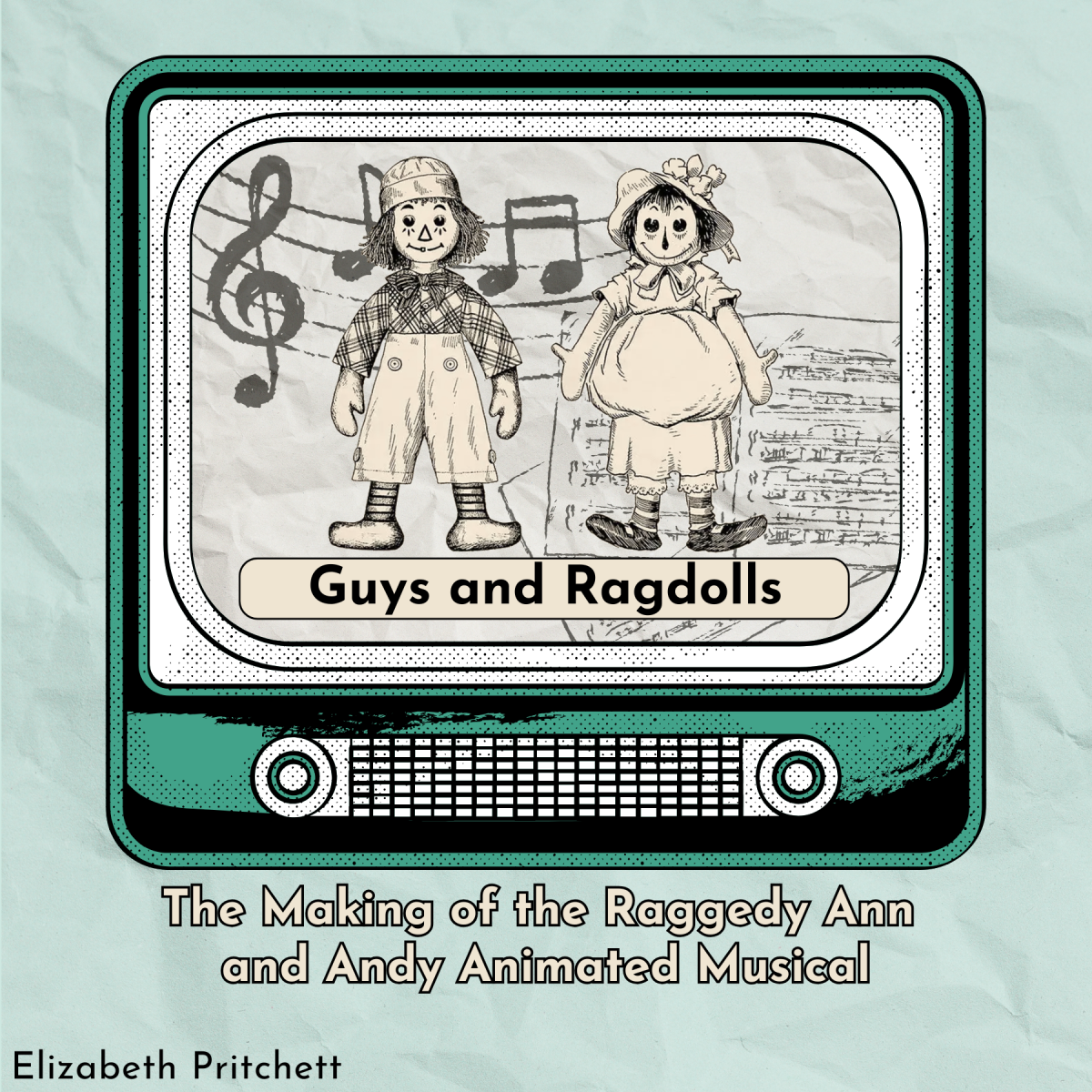
If you’re an American, odds are you’ve heard of Raggedy Ann. Unless you’re in niche animation communities (or the TADC fandom, I guess) odds are you haven’t heard of the animated musical film made in her image, “Raggedy Ann and Andy: A Musical Adventure.” A straightforward name for a movie that’s anything but.
For a couple of dolls that were so incredibly popular for so many decades in America, there comes an expectation that any movie with their names on it would be an instant success. The people making the movie certainly thought so. Unfortunately, due to a variety of reasons, the movie flopped, and is now relegated to “free on YouTube” status (go give it a watch!)
“Raggedy Ann and Andy: A Musical Adventure,” hereafter referred to as the Musical for the sake of not driving me insane, was released on April 1, 1997 (not a good sign). After a little over two years of painstaking work, getting some of the greatest animators in America at the time and running a multi-million dollar ad campaign, the movie proceeded to lose almost three million dollars.
Before getting into it, I should note that much of my information came from “The Animated Raggedy Ann and Andy” by John Canemaker. Almost all of the quotes and much of the information in this article were provided by this book. I recommend giving it a read if you’re interested in these dolls, but also if you’re interested in animation history at large, as the whole first section is dedicated just to that. I found an online copy that works well enough if you’re fine with the scourge of advertisements that plagues our declining society. I will try to cite information I get from the book using the format (Canemaker p#), for easier reading.
Before getting into the movie, I’d like to provide some brief context. I actually wrote an article a little while ago on this topic, which you should read (note: this article is not actually required reading, do what you will). That article was abbreviated, and this summary will ideally be even more abbreviated.
First, the man behind the ragdolls, a Mr. Johnny Gruelle. When asked about his father, Worth Gruelle says, “The myths [and] conflicting stories of course are typical [of] famous people who didn’t intend or expect to be famous — their lives could have been calm, peaceful, happy and maybe even uneventful and mediocre. However, most of this was true in our family — except for the uneventful and mediocre — it was a happy family!” (Canemaker 64). These “myths and conflicting stories” are something that Gruelle has come to slightly be known for, as there are all manner of origin stories for Raggedy Ann (and consequently Raggedy Andy, though he’s rarely mentioned in these stories). The consistent, and true, details are that the stories were made by Gruelle, primarily for his daughter Marcella who died at only 14. The specifics range from Marcella finding the doll in an attic and bringing it to her father (romantic, but untrue), all the way to the very gruesome permutation that Ann’s appearance was inspired by the look of Marcella’s dead body, succumbing at a young age to a vaccine injury (though true that Marcella died as a result of an unsterile vaccine, to our knowledge, the rest is used only to further a manipulative anti-vaccination narrative).
The problem is that Gruelle had a sense of humor, and liked to change the origin story whenever he was asked — it’s possible that many misconceptions came straight from him. Fortunately, his family members were a bit more straightforward. Myrtle Swann, Johnny Gruelle’s wife, went on record saying that Raggedy Ann had been found by Johnny in his parents’ attic some time before Marcella was born, though the stories were still inspired by Marcella’s games. Worth agreed with this, saying, “I remember an old stringy rag doll — but it must have been found before my folks actually moved to Conn. Maybe on a visit to their folks.” (Canemaker 67).
Though Gruelle had a habit of making stories, he did tell a more realistic account to the Indianapolis Star, regarding how he initially started putting the dolls to writing. Apparently, it was mostly due to him being a fast worker and having time to kill at his job, being a staff cartoonist at the Cleveland Press. “I got to doing things to take up the time — writing sketches and bum verses — you know the kind — and finally got to writing Raggedy Ann in verse, and making pictures for it. Raggedy Andy came later. P. F. Volland, the publisher, suggested I do it in prose, so I did, and it’s been in prose ever since” (Canemaker 67). This story can probably be accessed from the newspaper archive as well, but you can pay for that yourself.
There is a lot more detail I could go into, but for the sake of respecting your time and also mine I will shove it. The dolls became incredibly popular, and that’s all that matters here. Getting back on track with the movie, the subject of this article was not the first time someone had considered making a movie with these dolls. Understandable, considering all the money the Gruelle family and various other substituents were raking in from them. In a different timeline, the person to pick up that slack is actually Walt Disney himself. Worth recounts, “After my father died, my mother took material to Disney in California and of course was ushered in royally. But [Walt] told her, quote: ‘Myrtle, we won’t pay a cent for Raggedy Ann, as someday it’ll become public domain and we’ll have it for nothing’” (Canemaker 71). I would have expected nothing less from Mr. Disney.
Obviously, doing a film with Disney was off the table. The ragdolls were put to film on three occasions before the Musical took off, one by Fleischer studios in 1940 (the only interpretation that depicts them as romantically involved rather than siblings, this one can kick rocks) and two directed by Seymour Kneitel in 1944 and 1947 (neither of which I have watched and so have earned neither ire nor praise from me).
Finally, with some context out of the way, we can get to the subject of this article. To make a movie, you need people, and three big players in this production were Richard Horner (producer), Richard Williams (director) and Joe Raposo (musical director/composer).
Horner and Raposo came together with relative ease. Horner was born in Portland, OR, and acted in his first play in Corvallis, OR. After being an actor for a few years and moving to New York to pursue the passion, he eventually shifted to stage manager, and then general manager. As general manager he met Lester Osterman, and the two of them made the transition to from stage to television production with “The Littlest Angel” in 1969. After the success of the special, they looked for similar things to do next, “a story that would be a family story that could be musicalized,” as Horner put it. (Canemaker 81) Eventually, Raggedy Ann and Andy came up, and they soon after acquired the rights from Bobbs-Merrill to work on a live-action TV show featuring the dolls. To make the music, they went to Joe Raposo, critically acclaimed with his name attached to many stage productions, like “Charlie Brown” and most notably, “Sesame Street.” When asked to come on the project, he apparently said, “Sure, why not?” (Canemaker 83). From other quotes, he seemed to have approached most things with this blase attitude. Good for him.
Richard Williams was not as easy to nail down. An artist since childhood, he had incredible passion and incredible energy. “I had a master plan. I decided to become the very best at the commercial side, then master the techniques of the art of personality animation. I wanted it all” (Canemaker 71). Before the Musical he did animation for several movies, including “What’s New Pussycat,” and “The Return of the Pink Panther.” He even made his own fully animated version of “A Christmas Carol” in 1971, for which he won an Oscar. Within his animation studio he was able to work with animation greats, including Art Babbit, Chuck Jones and Grim Natwick. During it all he became known as a somewhat difficult person to work with, due in large part to his incredible perfectionism. Canemaker’s impression was as such, “If he were granted an eternal lifetime, he would love nothing more than to make an animated feature all by himself: he would — and could — design it, write it, do all the voices for it, animate it, paint it, shoot it and probably run the projector and sell the popcorn” (Canemaker 102).
At the time he was considered for working on the Musical, he had been working on an animated film of his own for the past twelve years. This was “The Thief and the Cobbler,” a movie so amazing that it would never be released (unless you count being unofficially uploaded on Youtube a release). The story of this movie could be its own blog post, and for the sake of a deadline I cannot go into it now, as much as that pains me. If you know anything about it, you know that it is a hilarious omen. For now, all that matters is that Williams needed money for this magnum opus.
Williams was first approached by Osterman in 1973, when the latter was on a business trip to London. Initially, his answer was no, but his tune changed when Osterman left him with the script and the songs that Roposo had already produced. Williams was impressed, more so than he’d expected, and negotiations began between the two studios. But these negotiations, for one reason or another, would lead to Williams bowing out.
Horner and Osterman would not give up so easily, though. Osterman sent many messages, asking Williams to work various smaller positions on the production. Nothing came of it. Finally, in a fit of anger at various changes some people had made to the script, Joe Raposo walked out and booked a flight to London, in the process threatening to leave the project for good. The threat didn’t really have any teeth, though. With some pushing from both Osterman and Raposo, Richard and Joe got drunk and went over the idea again. The fact of the matter was that Williams needed money for The Thief and the Cobbler, which had been a money pit since its conception, and the Musical was getting monetary backing from what was at the time a large and successful book publishing company. What ultimately won Williams over was Joe Raposo’s music. “The track will hold the picture,” he said, “We almost can’t miss, because of the soundtrack!” (Canemaker 107). With his position finally settled, he flew back to New York with Raposo to start work.
Initially, Williams was just meant to supervise the Musical, and he recruited Abe Levitov (whom he’d worked with before) to actually direct it. That plan went out the window when Levitov immediately got cancer. Williams filled his place with as much enthusiasm as you can have when taking the job of someone with cancer. (Canemaker 109). He was incredibly on board with what was already the animation prerogative, to make an animated movie-musical of Disney quality (Canemaker 79) without the Disney look. Instead, he studied Gruelle’s drawings and aimed to fit the style of the movie to the books’ illustrations.
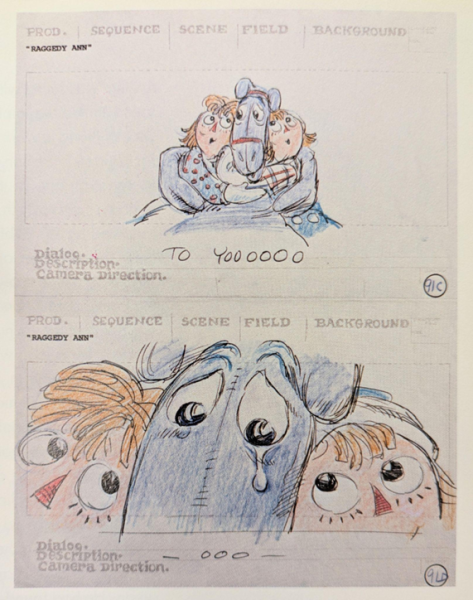
To bring this to fruition, he recruited one Cornelius Cole (or “Corny,” as he preferred to be credited) to design the movie. The two had met when Cole was working as an art director at MGM studios, after having bounced between jobs at Disney, Hannah-Barbara and a surfing magazine (even the best of us get art block every now and then). Williams had been stunned by Cole’s art for “The Phantom Tollbooth.” He insisted on meeting with Cole, and since had brought him to work on “The Thief and the Cobbler” a couple of times. To Williams, Cole was the perfect man for the job.
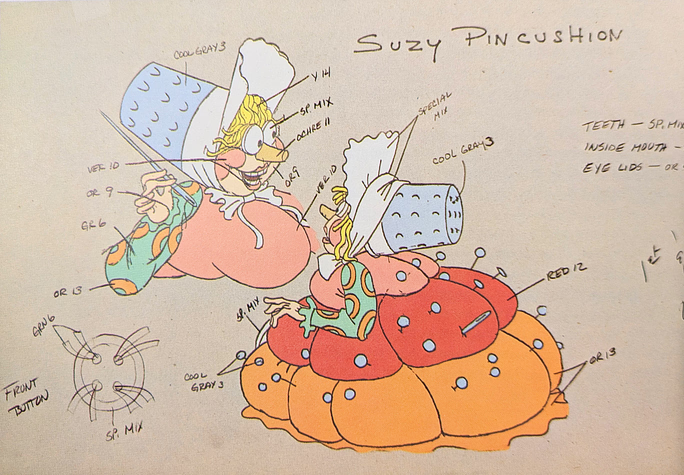
So perfect, in fact, that the initial plan was for Cole to do just about everything short of animating the damn thing. Character designs, layouts, color keys and all the storyboards. By all accounts, an absolutely ridiculous proposition. Fortunately for him, Cole was just as abnormally dedicated to the game as he was, and agreed immediately. “I knew if Dick Williams was going to be involved it was going to be a good project” (Canemaker 118).
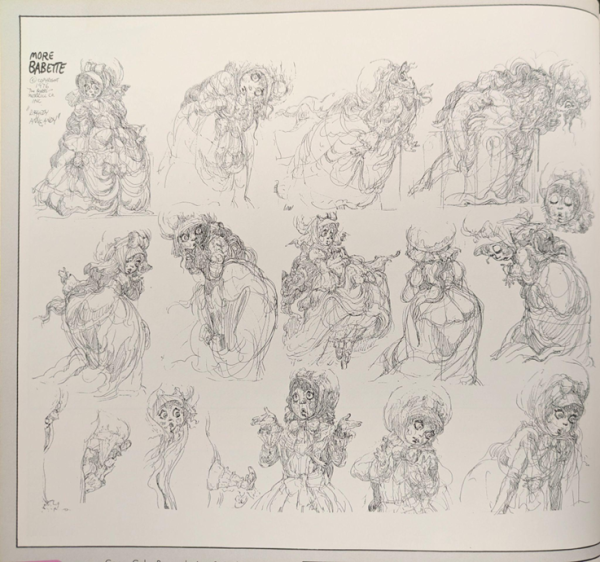
This brilliant plan was not to come to pass, as it quickly became clear that one man, no matter how good, simply cannot do half of the net artwork for an animated movie. This was difficult to accept for such serial perfectionists as Cole and Williams. Said Williams about Cole; “Corny accepts no limitations — period — for time or money. The better he likes a job, the more identified he becomes with it… He was five months late with some storyboards” (Canemaker 123). Though it was difficult to accept for such serial perfectionists as Cole and Williams, they would have to put some others to the tasks of storyboard, layout and design if they wanted to get the movie done within the century. Their perfectionism caused other conflicts, both with each other and with the larger crew, and when Cole’s contract ran out there was a push from some to get rid of him. But Williams was determined to keep him on the team, at any cost. As on many things, he would not be moved, and production continued.
With a small team assembled, now came an even harder part: Getting the go-ahead from Bobbs-Merrill/ITT to start production. Williams had been enchanted by the music, and had already assembled a few people who he thought to be the best for the job. Executives at Bobbs-Merrill/ITT were not to be so easily convinced. The doll franchise was successful, sure, a fully animated movie was a rather large ask.
“We’re competing with Disney in his own backyard. But we are trying to do it with one half the money and one-half the time that they require to do a film,” Williams said in a meeting with the executives. Not exactly encouraging words, but he was never one to let such issues as budget or timelines get him down. “I can do it!” he said confidently in another. “I can honestly say that my understanding and feel for the ingredients in the Raggedy Ann picture assure me that the bases are loaded for a sure-fire success” (Canemaker 127).
Another sticking point was the location of the animation studio. This issue concerned less the Bobbs-Merrill/ITT executives and more the producers, Horner and Ostermann, who were resistant to Williams’ idea of setting up a new one in California. They had apparently wanted to do that in New York, closer to where they were currently working. Williams countered, saying that, “… there is no feature cartoon studio in New York, and very few individuals familiar with feature cartoon production or even high-quality animated TV specials.” As for making an independent studio rather than contracting out to one of the smaller, preexisting ones, the reason was to save money — understandably, given the aforementioned tight budget. Finally, Williams reasoned that most of the animators that he wanted on the project, the list of which included greats like Art Babbit, Grim Natwick, and Emery Hawkins, lived in California. Tissa David, who had already done some work for them in creating the pencil test reel to show at these executive meetings, was the only animator on his list that lived in New York at the time (Canemaker 126).
After all was said and done, the movie was a go, and a new animation studio was set up in New York to produce the movie. Unfortunately for Williams, the lure of not moving across the country was too great. He would still have his animators, though, as there would be a smaller operation in California. Williams would have to be flying constantly coast-to-coast to manage the project, but he took the setback like a champ. As much as you can when you don’t have much of a choice in the matter, anyway.
The plan was such: Start production March 1, 1975. Have a Leica reel (animatic of the whole movie set to the voices and soundtrack) finished by the end of September of that same year, to review and edit. Deliver the finished product to Bobbs-Merrill/ITT on September 11, 1976. If all went as planned, they could release the movie around Christmas (Canemaker 130).
All things considered, the soundtrack production and voice acting went swimmingly. Horner was absolutely insistent that they use no celebrity voice actors, for a variety of reasons. One being that he thought that star voice actors took people out of the story. Another reason was that star voice actors were incredibly expensive, and they had a tight budget. As far as Horner was concerned, there was no reason to spend that much money when they could find comparable talent at a much lower price. “Since New York is the theatrical capital of the country, we have a great number of very talented actors here,” he said. “We felt we wanted people who could act these characters vocally, rather than just people who did cartoon voices” (Canemaker 138).
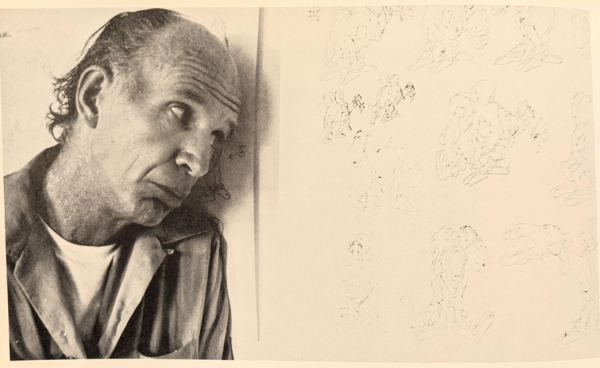
On May 1, 1975, auditions for voice actors began. Within the four days that followed, they found voices for Raggedy Ann, Raggedy Andy, and the Camel with the Wrinkled Knees all on the same day: That being Didi Conn (who thought it was a commercial gig going in), Mark Baker (who had recently starred in Candide on Broadway) and Fred Stuthman (who was hired in part because Williams thought that he looked like a camel) respectively.
During the week that they’d carved out for voice recording, later that May, Conn managed to contract laryngitis, but Williams thought it added to the performance. Overall, it seemed like everyone left that part of the process a happy camper. Said Conn after the fact, “I knew the project would be fantastic, because there was so much love and compassion and ease in the people who were putting it together that it had to go through the whole production. I’ve never before had the experience of working on a project where everybody liked each other. There was never any friction — never!”
With voices and music done and dusted, animation could begin. For that, they needed space. As planned, the main animation house was formed in New York, dubbed Raggedy Ann East. Raggedy Ann East took up several floors of the Berkley Building (Canemaker 241).
Raggedy Ann West, over in California, had a more unsteady start. They began their work in June of 1975. Originally all of the animators there (a team including Art Babbit and Cornelius Cole) were going to be working out of their homes. The animation coordinator, Carl Bell, would bring them scenes and art supplies, and take from them their finished work, mailing it to Raggedy Ann East. As the project grew and more animators were hired, though, it became clear that they needed a workspace. Fortunately for them, Art Babbit had recently visited Quartet Films Inc. (a studio he had helped to found) in order to see some pencil tests for a new project. He heard at that visit that they had some space available, and suggested to Horner and Ostermann that they snatch it up. Soon after, the upper floor of a two story building was leased to the project (Canemaker 225)
September 1975 came and went, and the Leica reel was not finished as they’d planned. In fact, they were nowhere near done. But that month they did succeed in finally acquiring the live-action Panavision lens they’d been after. The next month they filmed the live action scenes they needed, using a house lent to them by a couple in Boonton. Williams’ own daughter, Claire, acted as Marcella.
The new deadline for the Leica reel was mid-December, 1975. A variety of things were pressing back at them as they pushed forward in production. Having studios on opposite ends of the country was complicated, many artists fresh out of college had to be trained and shooting the animation cells (which required getting and making a lot of specific equipment that goes way over my head) were all factors that slowed things down significantly. Cole, in particular, had a habit of turning his storyboards in several months late (Canemaker 122).
Despite it all, they managed to meet their second deadline. Reactions to it were generally positive. The only notable issue was that it was too long; Williams decided that the length they should go for was 85 minutes, and to achieve that they would need to find a way to cut about 25 minutes from the existing reel (Canemaker 213).
The year rolled over, and production trekked on. As a couple months passed, the writing on the wall became clear: They were not going to meet their September 1976 deadline. Furthermore, they were over budget. In April the budget was increased and deadline postponed, now set to December 31, 1977, with a new planned release around Easter 1978.
The rest of the production process is broadly uninteresting. Animation continued slowly, but mostly on schedule. Work at Raggedy Ann West finished in October 1976, and a couple of them flew over to the east coast to continue working on the project. All there was to do was work, and pray that it got done on time.
Said work continued up until the final week of December. Much of the month was spent in crunch time, drawing frames, painting cells, and xeroxing film as fast as they could humanly manage. Painting cells in particular became one of the biggest risks to the deadline as it couldn’t be rushed, but with some extra shifts they pulled through. At that point the marketing department was doing their work with commercials, magazine ads, and a dance number in the 1976 Macy’s Thanksgiving Day Parade. The ad campaign ultimately added up to over two million dollars. With the movie set to play in four hundred theaters across the country, the stage was set for the movie to be a great success.
As I said all the way up at the beginning, the movie was not a great success. Despite all the effort, all the time and money and travel, the movie made back only about a third of the money that had been pumped into it.
It wasn’t a complete failure. Most praised Raposo’s score and the animation. But reviews were mixed. Many thought the songs were uninspired, or overly-saccharine. The pacing was rough and the plot too juvenile to be enjoyable to anyone over five (I take some offense to this). Characters were either delightful or irritating, depending on who you asked. Judith Martin called the plot, “a vague chase, peopled by formless villains.”
I am not a film critic, but I feel the need to say my own opinion of the movie.
Joe Raposo is a brilliant composer. There is only one song in the movie that I actively dislike, that being “You’re My Friend,” a slow, shrill, tuneless call-and-response between a captain and his parrot. The rest of the songs are wonderful, and “Blue” made me cry once. But while this movie is, I think, a good show of his ability to craft music, this movie is not a good display of his ability to craft music for musicals specifically.
I am no musical expert, I actually don’t listen to many at all, but in my limited experience the songs in a musical hold two purposes: introducing characters and progressing plot. Sometimes, both at once. “Beetlejuice: The Musical” is a good example of this (and one of the few I know well enough to use). “The Whole Being Dead Thing” is a character introduction song, and “Say My Name” is a plot progression song. “Ready, Set, Not Yet” is both.
My point in all this is to say that there are no songs in the Musical that notably progress the plot. Many songs are character introductions, and the few that aren’t are basically filler. Even an avid fan such as myself begins to tire once we reach “It’s Not Easy Being King,” as decent a song as it may be.
Visually, the movie is beautiful. The backgrounds during “Blue” make me feel a kind of deep bittersweet somber I didn’t know I was capable of, and the animation for the Greedy (credit to Emery Hawkins) is objectively incredible. But some sequences have been described by everyone I know as “acid trip-like,” and I unfortunately see where they’re coming from. The appearance of the movie carries with it the same Williams DNA that can be seen in “The Thief and the Cobbler.” Intricate, smooth and artsy. To some, including myself, that’s part of the charm. But it is objectively pretty unmarketable to a mainstream audience. I am always a proponent of making art for yourself, without worrying too much about wide appeal — however, that line of thinking doesn’t work as well when you’re asking a company for four million dollars to make your animation passion project. Maybe you can see why “The Thief and the Cobbler” didn’t work out.
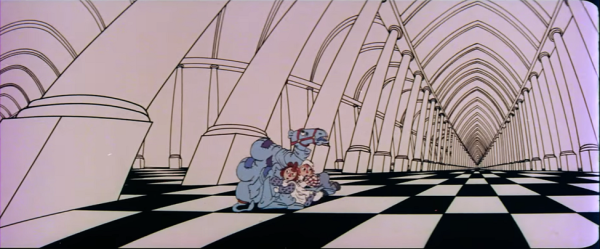
So, do I think you should watch this movie? Yes. Very much so. Whether you love or hate dolls, I think there’s something there for everyone. If nothing else, it’s incredibly sincere, and I think we all need some of that right now. Take a break from the crushing pressure of midterms and finals and watch a couple of ragdolls sing about candy hearts and paper flowers. It certainly couldn’t make things worse.